
Fifty feet is one of those measurements that shows up constantly in real life yet rarely gets noticed. From the width of a basketball court to the length of a semi-trailer rolling down the highway, 50 feet defines spaces we move through every single day.
Whether you’re sizing up outdoor spaces, estimating safety distances, or simply trying to make sense of real-world sizes, this substantial measurement is more comprehensible and practical than most people realize.
How Long Is 50 Feet?
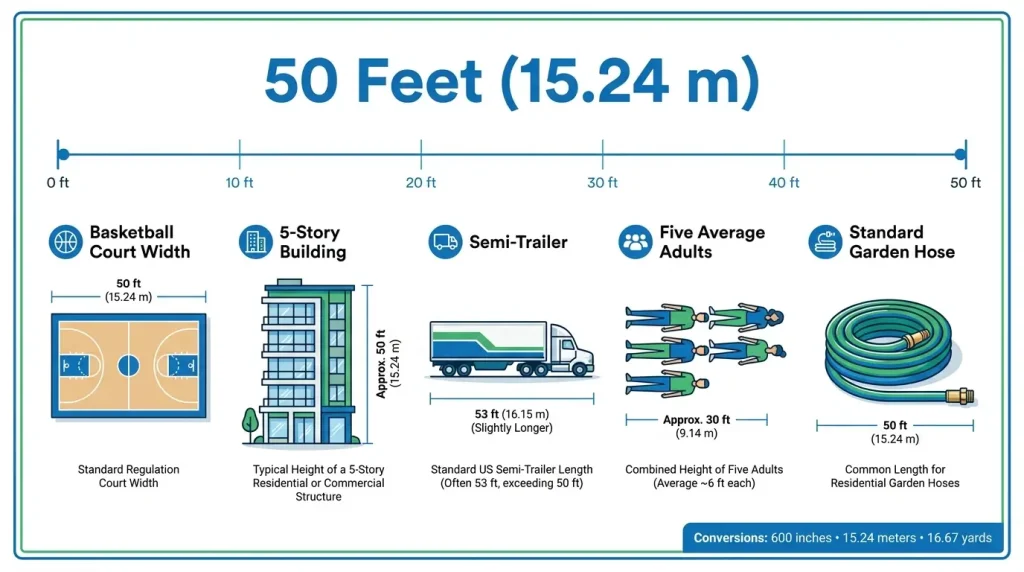
Fifty feet equals the combined length of roughly one standard school bus plus an extra car length added to its rear. Stand nine to ten people stretched out head-to-toe, and you’ve visualized it precisely. At a normal pace, an average adult covers this substantial distance in 17 to 20 seconds. It’s a noticeable distance across any open setting.
50 feet = 600 inches = 1,524 centimeters = 15.24 meters = 16.67 yards
How short or long is a 50-foot walk?
At a steady 3 mph, an average adult covers 50 feet in roughly 11.4 seconds, making it an incredibly short walk yet surprisingly useful as a reference point.
Picture crossing from one sidewalk to another across a two-lane road, that gap sits right around this mark. Whether indoors at an office or outdoors in a park, counting just 18 to 20 steps at roughly 2.5 feet each gets you there almost perfectly every time.
1. Basketball Court Width
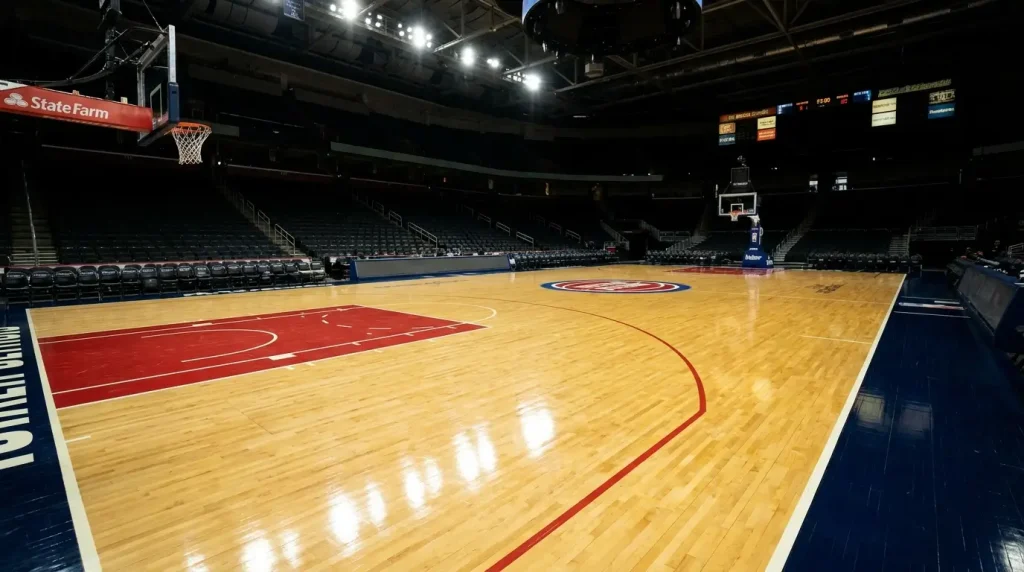
Few people standing on the sideline of an NBA court realize the width they’re staring across is precisely 50 feet wide. This standard dimension isn’t arbitrary; international guidelines and regulation courts worldwide enforce it to support proper player positioning, defensive formations, and fluid offensive movements.
Professional venues are built around these exact court dimensions because even minor variations disrupt game tactics and team movements.
2. Semi-Trailer
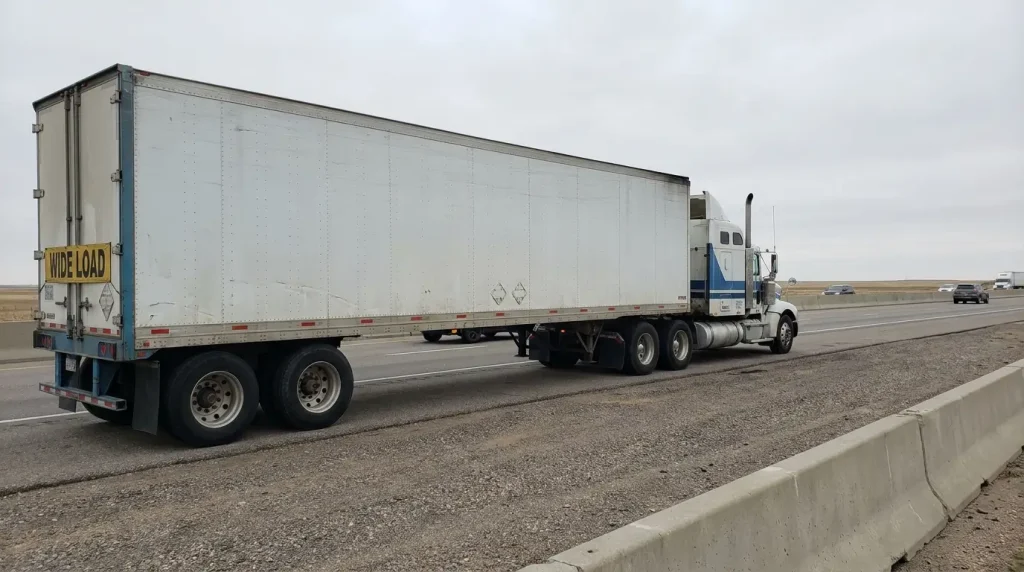
A standard semi-trailer measures 48 feet in length, sitting just under the 50 ft benchmark while still serving as one of the most practical visual comparisons available on any highway. The full unit including cab and chassis can push between 45 to 50 feet, and when a trailer is attached, total length climbs well past 70 feet.
Trucking industry professionals depend on precise construction measurements for loading docks, maneuvering areas, and road safety regulations that govern shipping routes across distribution centers and warehouses daily.
3. 5-Story Building

Stand at the base of any 5-story building and look straight up; that vertical height is almost exactly 50 ft. Each floor typically spans 10 to 12 feet, accounting for structural elements like ceiling thickness and floor systems beneath your feet.
Architects designing residential towers and office spaces in dense urban landscapes use this height as a baseline for safety regulations including fire escape placement and load distribution.
In compact urban spaces, a small apartment building of five stories quietly demonstrates this measurement without anyone consciously registering it.
4. Humpback Whale

Among marine creatures, the humpback whale stands as perhaps the most breathtaking natural reference for 50 feet. Adults in the Northern Hemisphere typically reach 49 to 52 feet, while those in the Southern Hemisphere grow even larger, with some touching 60 feet.
Females tend to outgrow males noticeably, with mature individuals weighing between 55,000 to 88,000 pounds or roughly 25 to 40 metric tons.
Their graceful movements through open ocean waters and dramatic breaching displays make these incredible creatures a living, swimming representation of what 50 feet long genuinely looks like in nature.
5. Grey Whale

The gray whale cruises the North Pacific as one of the ocean’s most compelling marine mammals, stretching between 42 to 49 feet in body length and tipping the scales at 15 to 40 tons or 60,000 to 90,000 pounds. Unlike other aquatic animals, this species favors shallow waters for feeding, making its enormous size surprisingly visible from shore.
Females grow notably longer than males, reinforcing why this species commands respect in marine biology circles. As an ocean marvel, the majestic gray whale embodies raw natural power while offering one of the most striking marine life references for understanding 12.8 to 15 meters in real scale.
6. Five Alligators

The American alligator found across the southeastern United States offers one of the most relatable and viscerally engaging mental references for grasping 50 feet.
A mature specimen averages around 10 feet in body length, meaning five alligators placed end-to-end would stretch exactly to that mark. Beyond being a memorable visual example, this comparison carries genuine educational purposes within wildlife and conservation contexts.
7. Five Amur Tigers
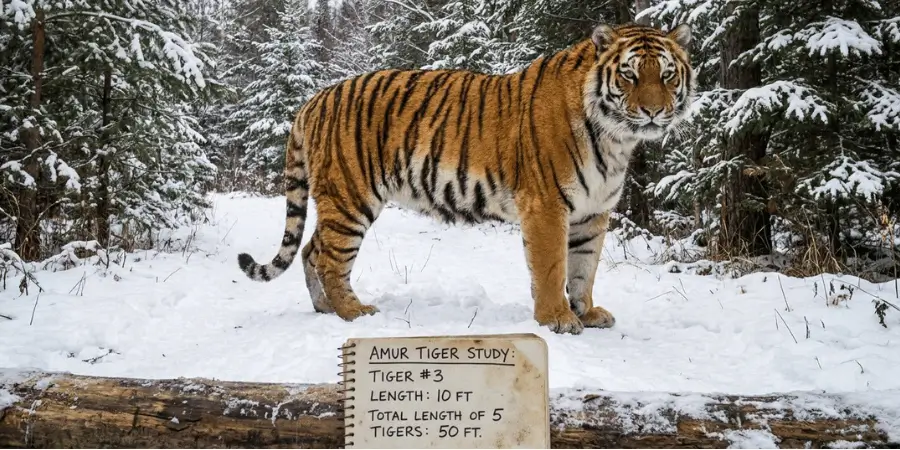
Siberian tigers, more formally called Amur tigers, rank among the largest wild cats on Earth, with males reaching up to 10 feet long and females measuring between 8 to 9 feet. Line up five tigers stretched nose to tail and the total span hits precisely 50 feet. Their iconic orange coat and sharp black stripes contrast brilliantly against snow, while thick fur shields them through brutal Siberian winters.
Wildlife conservationists studying territorial needs and hunting patterns rely on body scale data to determine habitat requirements that sustain each animal’s role within its broader ecosystem and keep this wild species alive.
8. 5 Ping Pong Tables
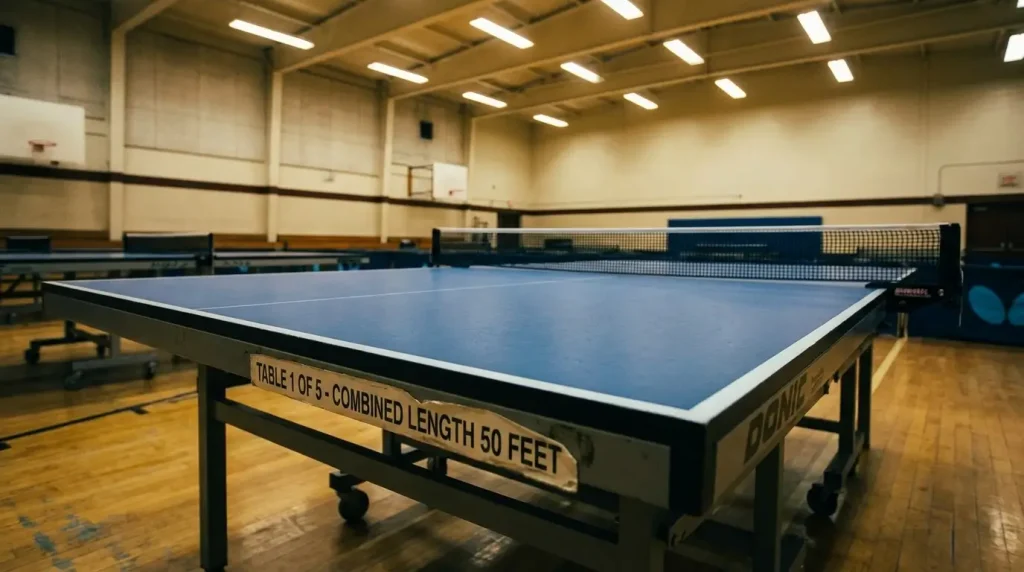
Arrange five tables in a single row inside any gymnasium and the combined span hits exactly fifty feet. Each ping pong table measures 10 feet long and 5 feet wide, sitting roughly 30 inches off the floor with a net rising about 6 inches above the playing surface.
For sports lovers and event planning professionals, this setup offers an immediately practical tool for visualizing space within indoor venues
9. Two and a Half Shipping Containers

Standard shipping containers dominate global logistics as the backbone of global commerce, typically manufactured in 20-foot or 40-foot lengths. Connect two and a half containers end to end and the total reaches exactly 50 feet, a configuration frequently spotted at busy ports where cargo storage demands creative space utilization.
Beyond transportation, these units serve warehouses, pop-up events, and modular facility builds where organized movement of goods is critical.
10. Garden Hose
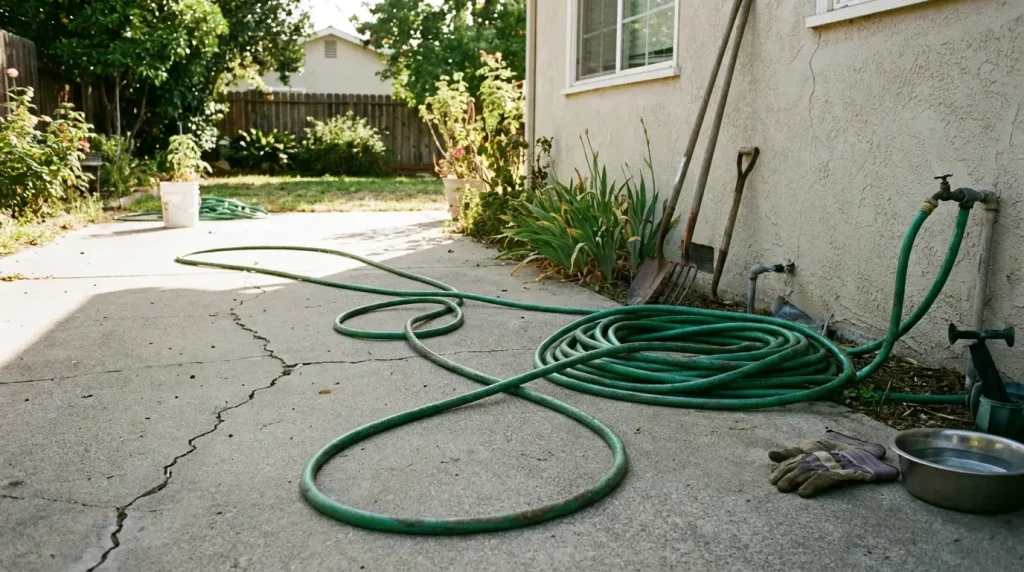
Most homeowners never stop to consider that their standard garden hose coiled neatly beside the garage already measures exactly 50 feet, the most common residential length sold across hardware stores nationwide.
This practical and flexible tool reaches virtually every corner of typical suburban homes, handling everything from lawn watering to a quick car washing session without requiring an extension.
Sizes range from 25 feet for compact yards up to 75 feet and 100 feet for larger residential yards, but the 50 feet option consistently dominates sales because it balances reach, weight, and everyday usability better than any other available length.
11. Futsal Court Width
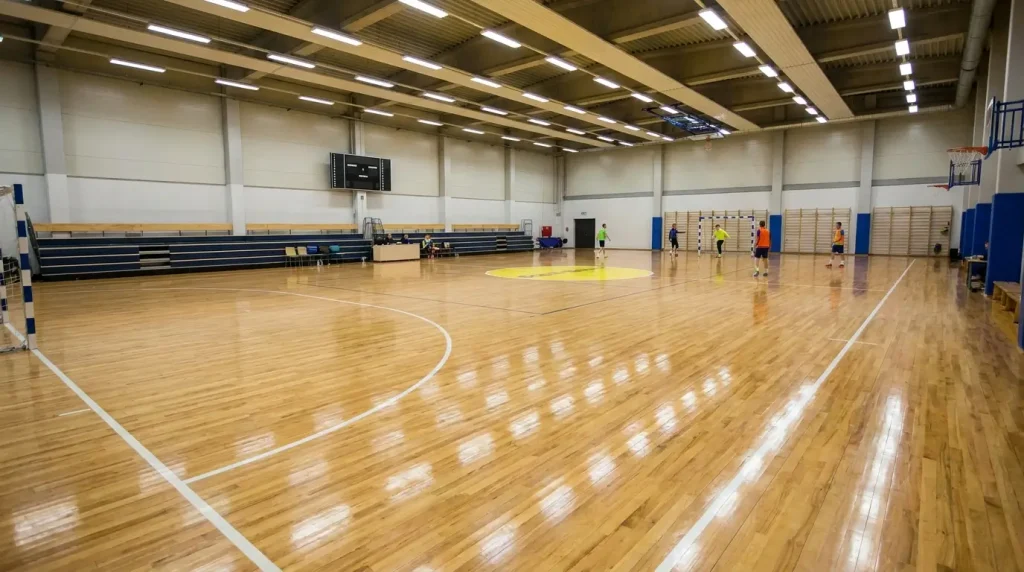
Futsal court dimensions reveal something genuinely interesting about how 50 feet appears across competitive sports infrastructure. Under FIFA Laws of the Game, national competitions permit a minimum width of 16 meters or roughly 52.5 feet, sitting remarkably close to the target mark.
International futsal matches require broader playing surfaces, ranging from 20 meters at 65.6 feet up to 25 meters at 82 feet depending on competition levels.
These standardized dimensions ensure consistent gameplay regardless of venue requirements, making official measurements a non-negotiable foundation for this fast-paced indoor soccer variant that rewards spatial awareness above almost every other technical skill on the court.
12. Hollywood Sign

Perched dramatically across the hills of Los Angeles, the Hollywood Sign has functioned as a towering landmark since 1923, with each of its bold letters standing 45 feet tall, just shy of the 50 feet threshold yet close enough to serve as a powerful reference point.
Beyond its role as a global symbol of American cinema and American culture, the structure doubles as an unexpected measurement anchor for urban design professionals and curious tourists alike.
Photographers and scenic locations enthusiasts who’ve stood beneath it understand instinctively how this piece of cinematic history communicates raw vertical height in ways that movies and art rarely capture.
13. Red Alder

The Red Alder (Alnus rubra) is the largest alder species in North America, reaching 40 to 50 feet relatively quickly, while mature specimens under favorable conditions tower between 65 and 100 feet, more than doubling what most common landscaping hardwoods ever achieve.
It colonizes riverbanks and disturbed soils rapidly through a symbiotic relationship with Frankia bacteria, fixing atmospheric nitrogen that continuously enriches surrounding soil quality and ecosystem health.
Its timber, valued for uniform grain and workability, serves furniture manufacturing, cabinetry, and electric guitar body production, making a mature Red Alder a striking natural benchmark for understanding genuine vertical scale.
Faq’s
What does a distance of 50 feet look like visually?
50 feet is roughly the width of a basketball court or five compact cars placed end-to-end. Vertically, a four-story building height communicates it clearly. Once you connect this distance to these familiar anchors, spotting it across any open space becomes instinctive.
How many stories or floors make up 50 feet in height?
A typical building allocates roughly 10 to 12 feet per floor, covering structural thickness, ceiling space, and floor height combined. By that standard, 50 feet stacks up to approximately 4 to 5 floors depending on construction style. Commercial builds run closer to five while residential ones often land at four.
What is the equivalent of 50 feet in meters?
50 feet converts cleanly to 15.24 meters using standard metric conversion. For quick reference, that figure also equals 600 inches or 16.67 yards. A useful mental anchor is a standard bowling lane, which runs close to this length, making the metric equivalent easier to internalize without reaching for a calculator every time.
How many average cars lined up would equal 50 feet?
It depends on vehicle size. Compact cars measuring 10 to 12 feet require about 5 vehicles placed end-to-end to reach 50 feet. Mid-size sedans running 15 to 16 feet get there in roughly 3 cars. So anywhere between 3 to 5 car lengths covers this distance, making parking lots a surprisingly practical place to visualize it.
How does 50 feet compare to the height of a person?
The average person stands around 5.5 feet tall. Stack roughly 8 average-height adults vertically and the combined height reaches 50 feet, similar to a medium-sized building viewed from street level.
How long does it take to walk a distance of 50 feet?
Walking at a comfortable 3 mph, most people cover 50 feet in approximately 11.4 seconds. Taking around 18 to 20 steps at a natural stride of 2.5 feet each gets you there almost exactly.
Should it be written as “feet long” or “foot long”?
Grammar here is straightforward. Use “feet long” when stating a standalone measurement over one foot, as in “the rope is 50 feet long.” Reserve “foot” for singular references or as a compound adjective paired with a hyphen, such as a “50-foot rope.” Mixing these up is a common writing error, but the usage rule is simple once you recognize the pattern clearly.